Lighting is easy to overlook until it goes wrong: a flickering tube in the dining room, a dim corner of the warehouse, a power bill that keeps climbing. Good commercial lighting does three jobs at once. It helps people see and work safely, it shapes how customers feel in your space, and it controls what you spend on electricity. Here is what to know before you plan a commercial lighting installation in Houston.


Why Houston Businesses Upgrade
Houston’s long cooling season makes lighting a bigger cost than it first appears. Older fluorescent, halogen and metal halide fixtures use more power and give off more heat, which your air conditioning then has to remove. Modern LED systems use considerably less energy, produce far less heat and last tens of thousands of hours, so there is less maintenance and fewer ladder trips to swap burnt-out tubes.
Quality matters as much as cost. Even, well-chosen lighting makes a store look more inviting, a workspace less tiring and a parking lot safer after dark.
Lighting Needs Change With the Space
There is no single right answer. What suits a boutique would be wrong for a warehouse. A few common examples:
Retail. Light should make products look their best. Accent lighting draws attention to displays, while a bright, even base layer keeps the store welcoming. Colors need to look true, so higher color-rendering fixtures are worth considering.
Restaurants and cafes. Warmer tones and dimming control create atmosphere. The kitchen, in contrast, needs bright, shadow-free task lighting and fixtures that handle heat and moisture.
Offices and clinics. The goal is comfortable, glare-free light that reduces eye strain. Neutral color temperatures and good fixture placement help people concentrate. Clinics and salons often need accurate color rendering as well.
Warehouses and industrial spaces. High-bay fixtures with strong, uniform output improve safety and productivity, and sensors can turn off lights in unused aisles.
Exterior and parking areas. Pole lights, wall packs and entrance lighting improve safety and visibility. In Houston’s humid, rainy climate, outdoor fixtures should be rated for wet locations.
Mr. Nguyen: 346-900-4000
Three Numbers Worth Knowing
You don’t need to be a lighting designer, but three terms will help you talk to a contractor:
- Brightness (lumens and footcandles). How much light is produced and how much actually reaches the surface where people work.
- Color temperature (Kelvin). Roughly 2700K to 3000K is warm and cozy, 3500K to 4000K is neutral, and 5000K and above is cool and crisp.
- Color rendering (CRI). How accurately colors appear under the light. Higher numbers matter for retail, beauty and food.
Retrofit or New Installation?
Retrofit. If your wiring is sound, existing fixtures can often be replaced with LED equivalents, or the lamps converted. This is faster, creates less disruption and delivers the energy savings quickly.
New installation. Tenant build-outs, renovations and expansions usually call for a fresh layout. That is the chance to place fixtures properly, add circuits where needed and plan controls from the start instead of working around old decisions.
An on-site walkthrough shows which route makes more sense, and sometimes the answer is a mix of both.
Mr. Nguyen: 346-900-4000
Controls That Cut Waste
Fixtures are only half the story. Controls decide when and how they run:
- Occupancy sensors switch off lights in empty rooms, storage areas and restrooms.
- Dimmers let you adjust the mood or save power at quiet times.
- Daylight sensors reduce output near windows and skylights.
- Timers and schedules handle signage, exterior lighting and after-hours settings.
Where a space needs new circuits, dimming systems or extra power for the fixtures, our Electrical Services team handles the supporting work so the lighting plan and the electrical system fit together.
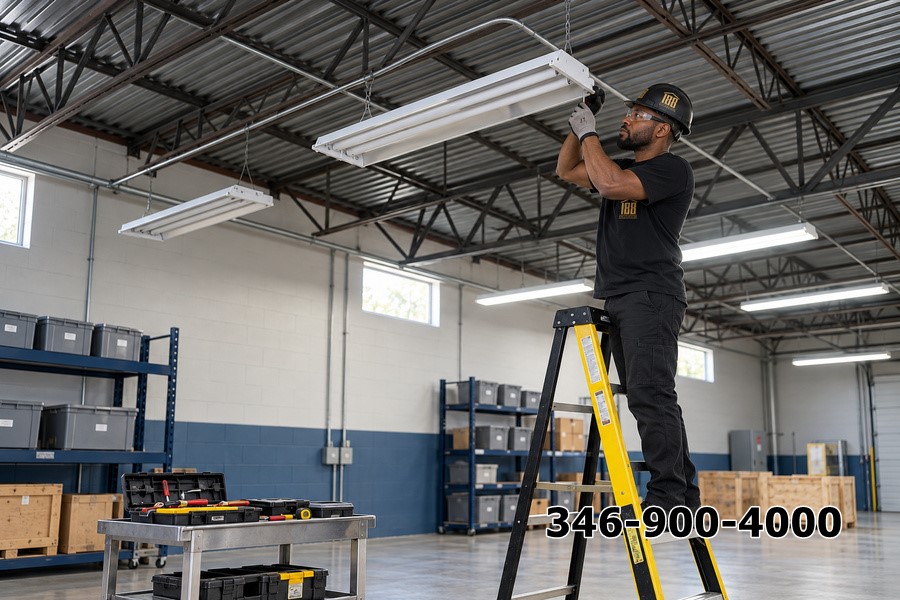
Safety and Code Requirements
Commercial buildings have lighting requirements that residential projects don’t. Exit signs and emergency egress lighting keep people able to leave safely during an outage or evacuation, and they need to be inspected and tested. Electrical and energy codes also govern wiring, fixtures and efficiency, and permits and inspections may apply depending on the scope. Backup lighting matters in a city that deals with severe storms and power interruptions.
Mr. Nguyen: 346-900-4000
Planning the Load Properly
A lighting project places new demands on circuits, panels and controls. Before installation, the fixture layout and total load need to be worked out so that circuits aren’t overloaded and the lighting performs as designed. This is where engineering rigor pays off. 188 CONSTRUCTION has engineers with Master’s degrees on the team, and we are licensed and insured, so the layout, load calculations and code compliance are handled before any ceiling is opened. That planning is what makes the difference between lighting that merely turns on and lighting that performs well for years.
Installing Without Interrupting Business
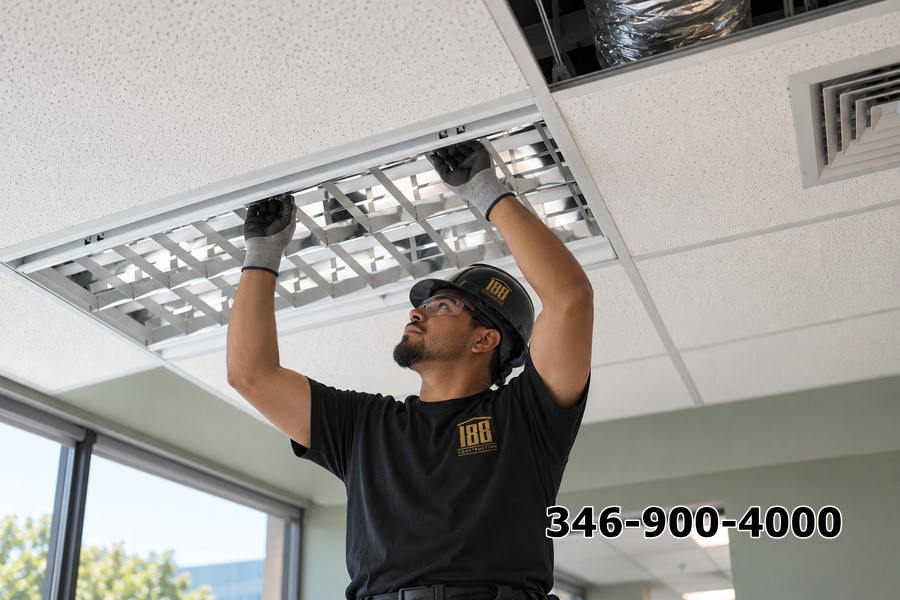
Closing your doors to rewire a ceiling isn’t an option for most businesses. A well-run project is scheduled around you: after-hours or weekend work, phased areas so part of the space stays in use, and tidy cleanup so you can open on time.
What Affects the Cost
- The number and type of fixtures
- Ceiling height and access
- Whether the project is a retrofit or a new layout
- Controls, dimming and emergency systems
- Condition of the existing wiring and panel
- Permits and inspections
- Exterior work, including poles and trenching
Utility rebates or efficiency programs may be available for qualifying commercial upgrades, so ask before you buy. An itemized estimate after a site visit gives you real numbers to compare.
If your business is ready for lighting that looks better, runs cheaper and needs less upkeep, let 188 CONSTRUCTION walk through your space and recommend a plan that fits your layout and budget. Reach out to Mr. Nguyễn at 346 900 4000 to arrange a visit and get a quote.